task
For people who send money home.
In Colombia and the Philippines people need crypto for ordinary things: sending money to family, getting around a bank that blocks a transfer.
I ran 10 interviews in Latin America: five with people already trading on Binance P2P, and five with freelancers and migrants who struggle to send money. Building the service for the second group was my proposal, and I made the case for it to the PM. One of them, a taxi driver in Los Angeles, sent money home to Colombia this way.
The interviews gave three findings. Everyone is afraid of scammers. People pay in cash or by bank transfer, not by card, and the phone is old. Nobody knows what a network is or where the fees come from.
The mechanics of a blockchain can’t be simplified, but they can be made to feel simple.
principle
The brand is loud outside the app and quiet inside it.
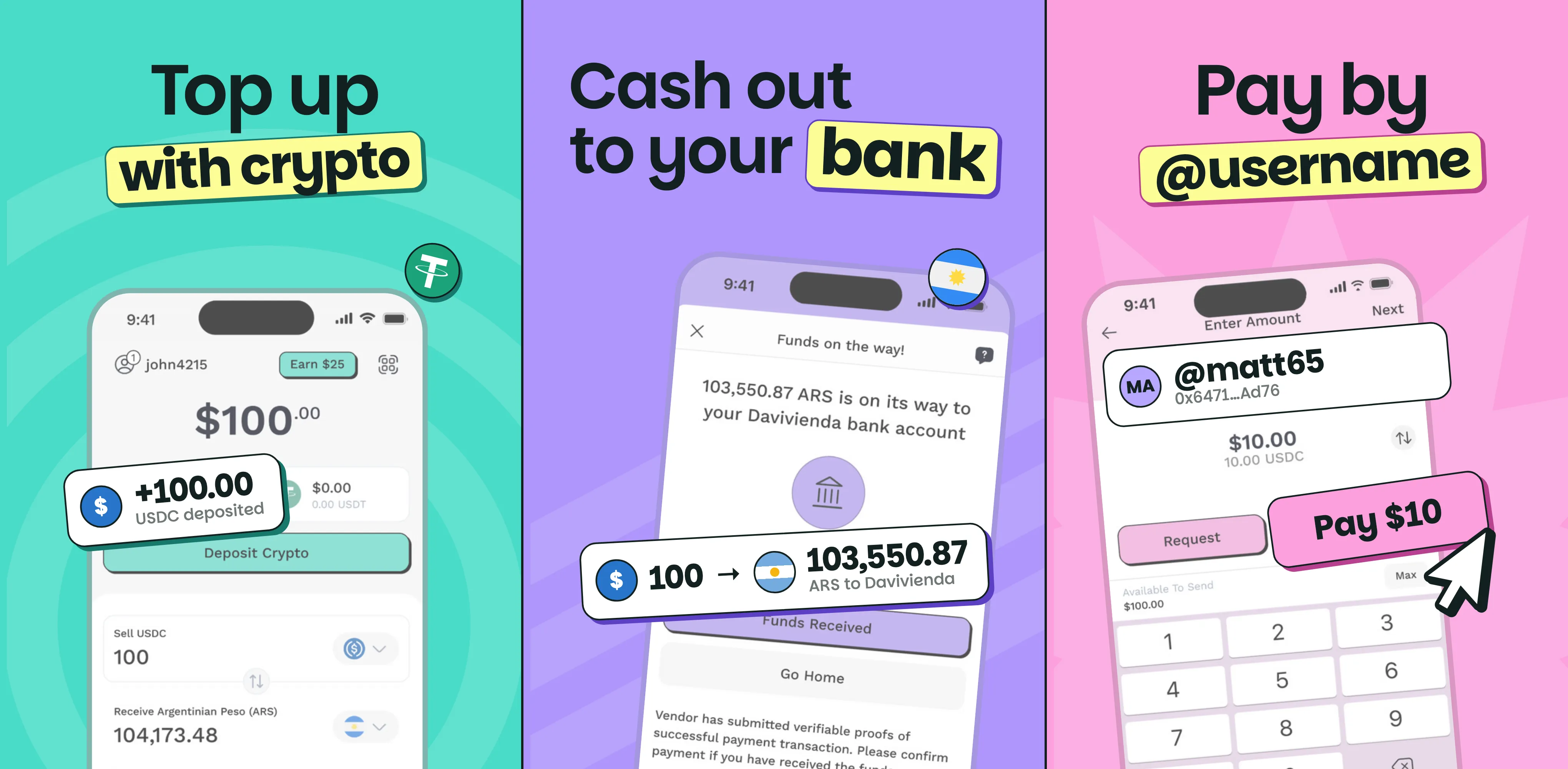
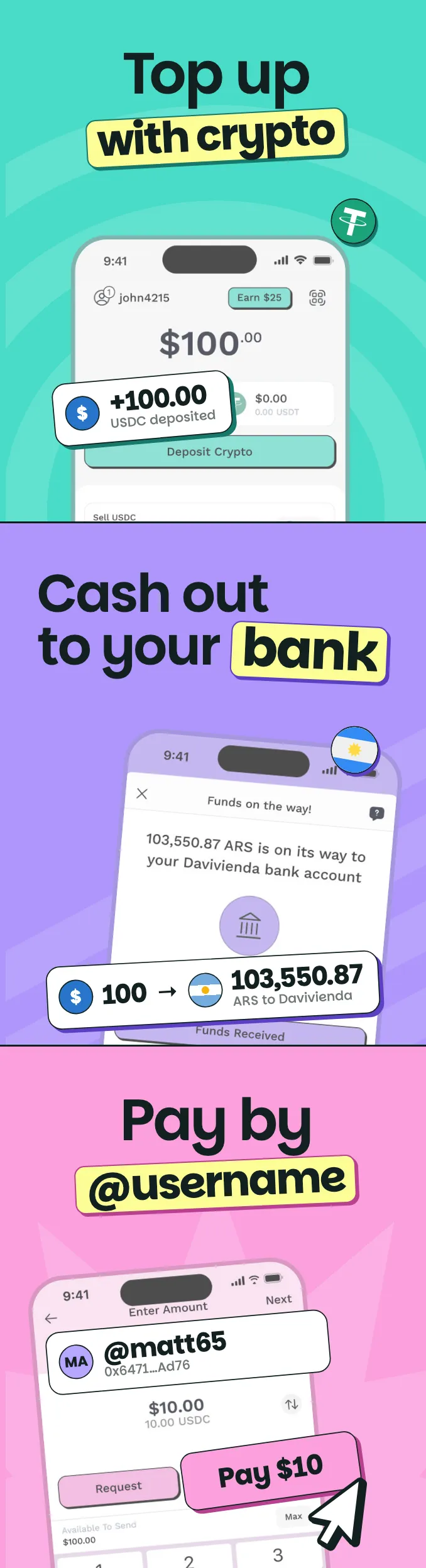
Outside, the brand has to stop a person on the street and in the feed. Inside, they are scared enough already, so the app keeps only the colour of the section.
brand
Colours and shapes from the chicha posters.
Crypto brands promise the future with neon and gradients, while our people need a clear transfer today. So the brand takes its palette and its shapes from the Peruvian chicha posters on their street.
system
The components were tried on the landing page first.
I tested the components on the landing page and only then built 389 tokens on three levels from them, with documentation for the front end. Flat colour without gradients or blur is cheap to draw on an old phone.
decision 1
The service picks the seller.
On a usual P2P market people find and check the seller themselves, and for someone afraid of scammers every such step is a risk. In UNIGOX a Dutch auction runs in the background, and the person sees the best offer straight away.
decision 2
The money goes to a local bank or e-wallet.
Hardly anyone pays by card, so money from a sale goes where people already keep it: a local bank, an e-wallet or an Efecty cash point. The details are saved once, and the sale screen then says where the money goes and when it arrives.
decision 3
Every wait is named on the screen.
Many people didn’t understand why money is frozen during a trade. So every wait has a name and a time, and the explanation sits on the screen itself, not in a help page.
The seller’s payment is checked with zk-TLS: the service gets a proof of the transfer, not personal data.
decision 4
Transfers go to a username.
A network means nothing to people, so transfers inside UNIGOX run on its own network, and the recipient is found by @username, email or phone number.
decision 5
Anyone can become a seller.
A market has two sides, and without sellers the auction has no one to choose from. So becoming a seller is as simple as selling.
with the team
All six flows on one map.
I drew the logic of all six flows on one map and used it to agree with the developers what the interface handles, what the backend handles and which states each screen has. I checked the layouts in tests with users and in front-end reviews with the developers.
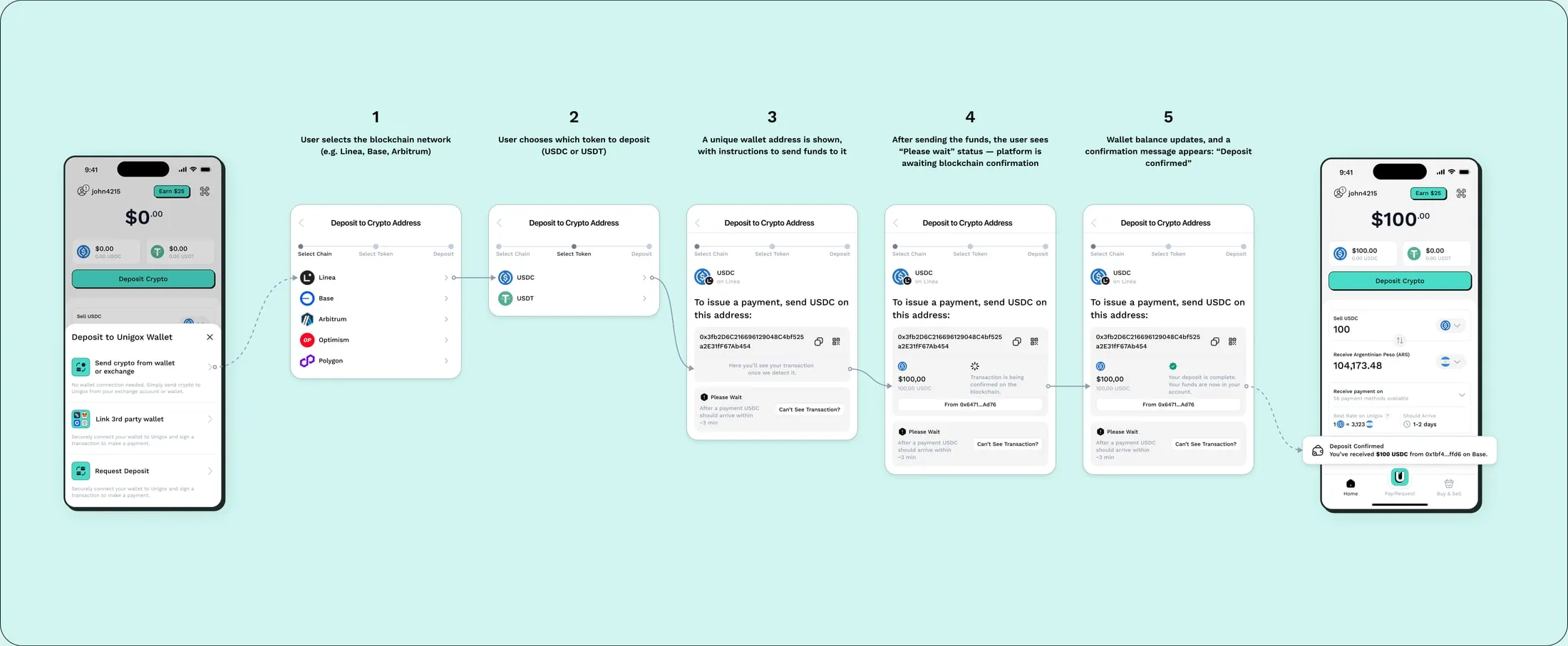 Deposit
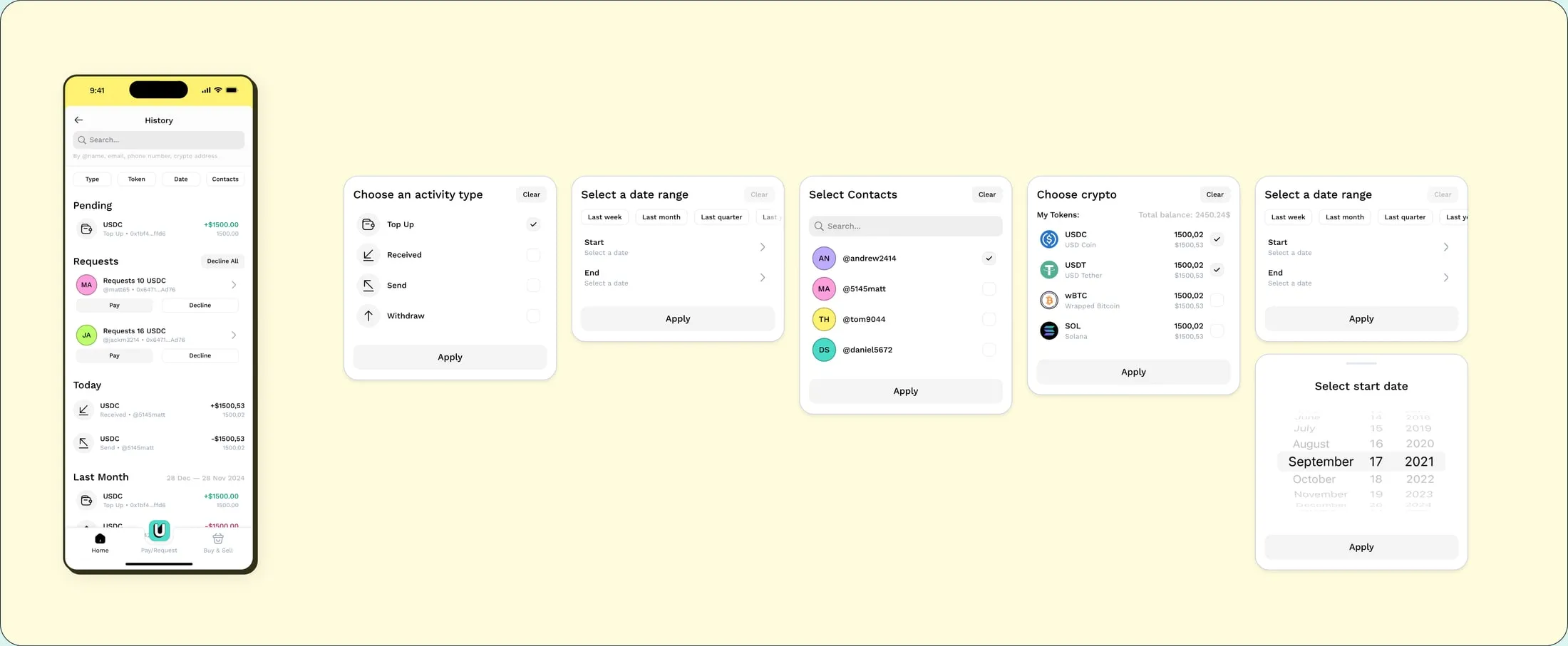 Transaction history and its filters
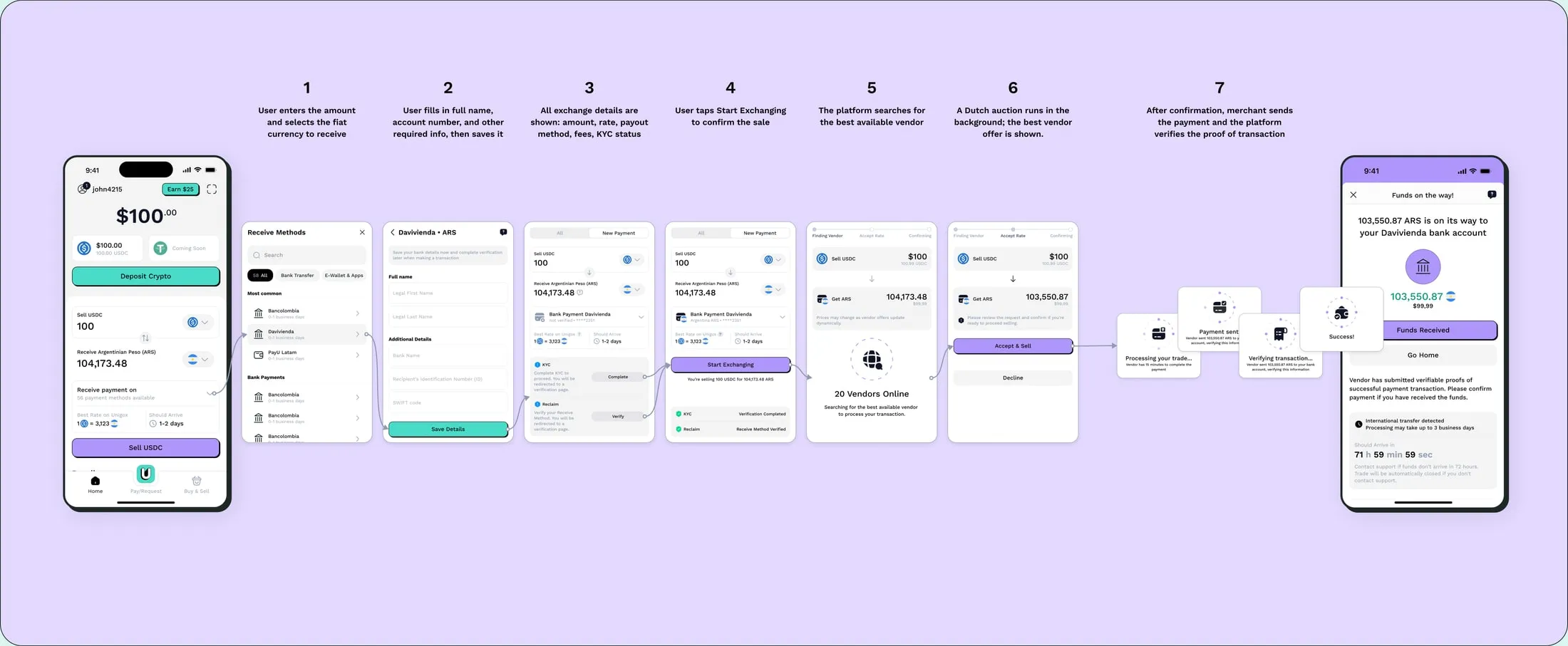 Sell
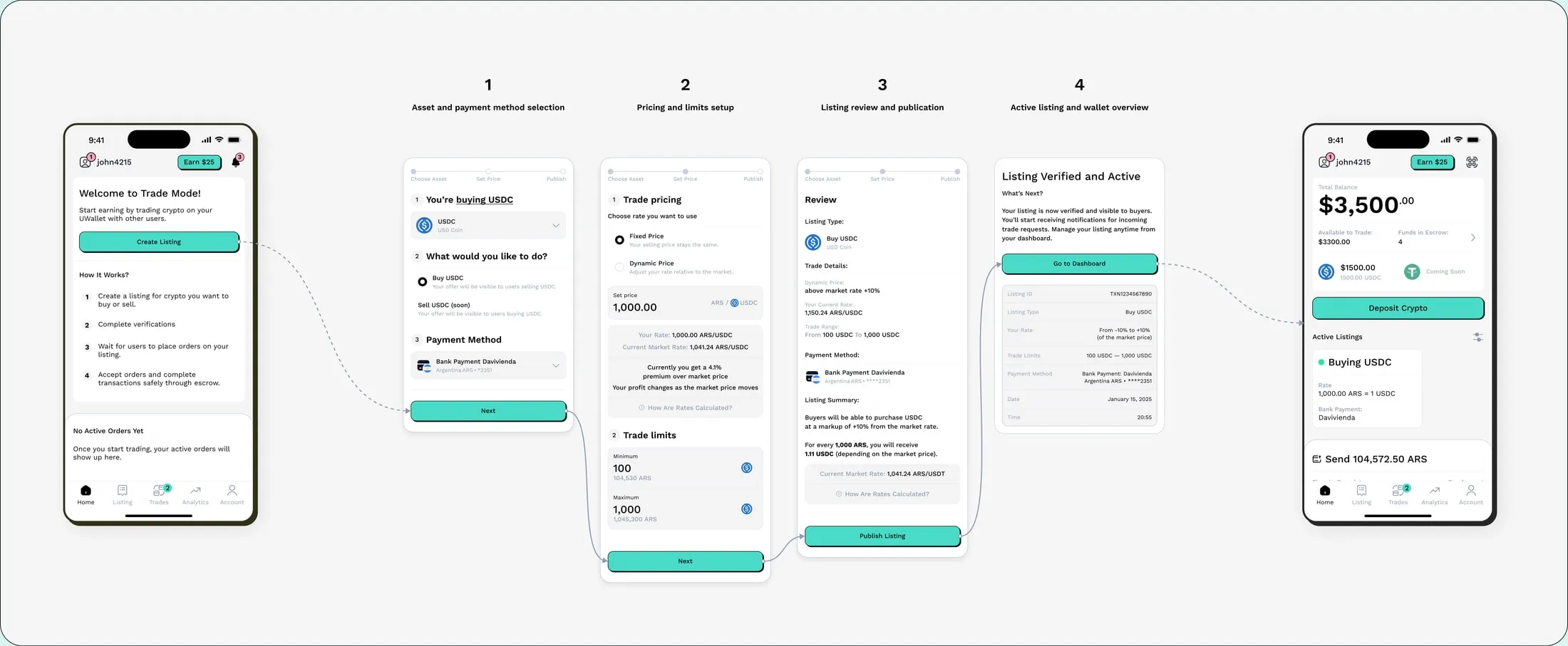 Trade mode
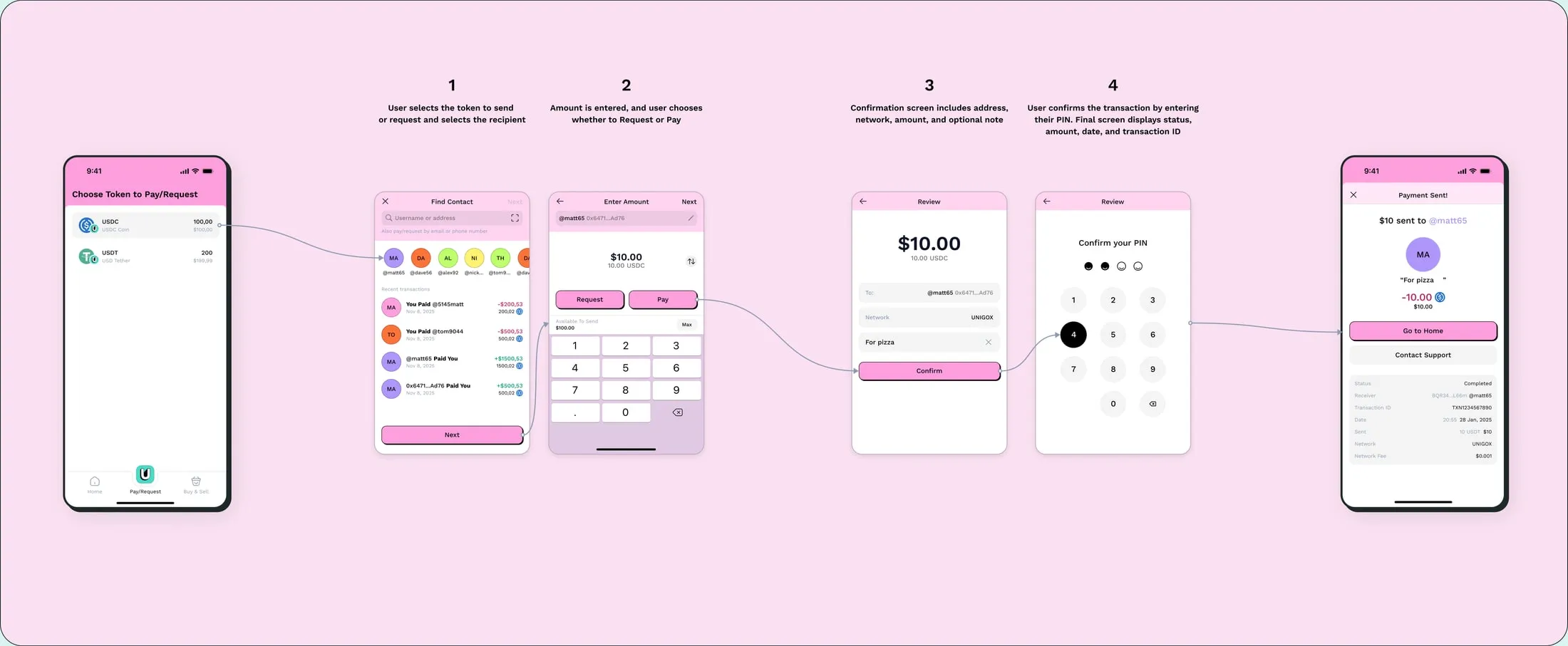 Pay and request by username
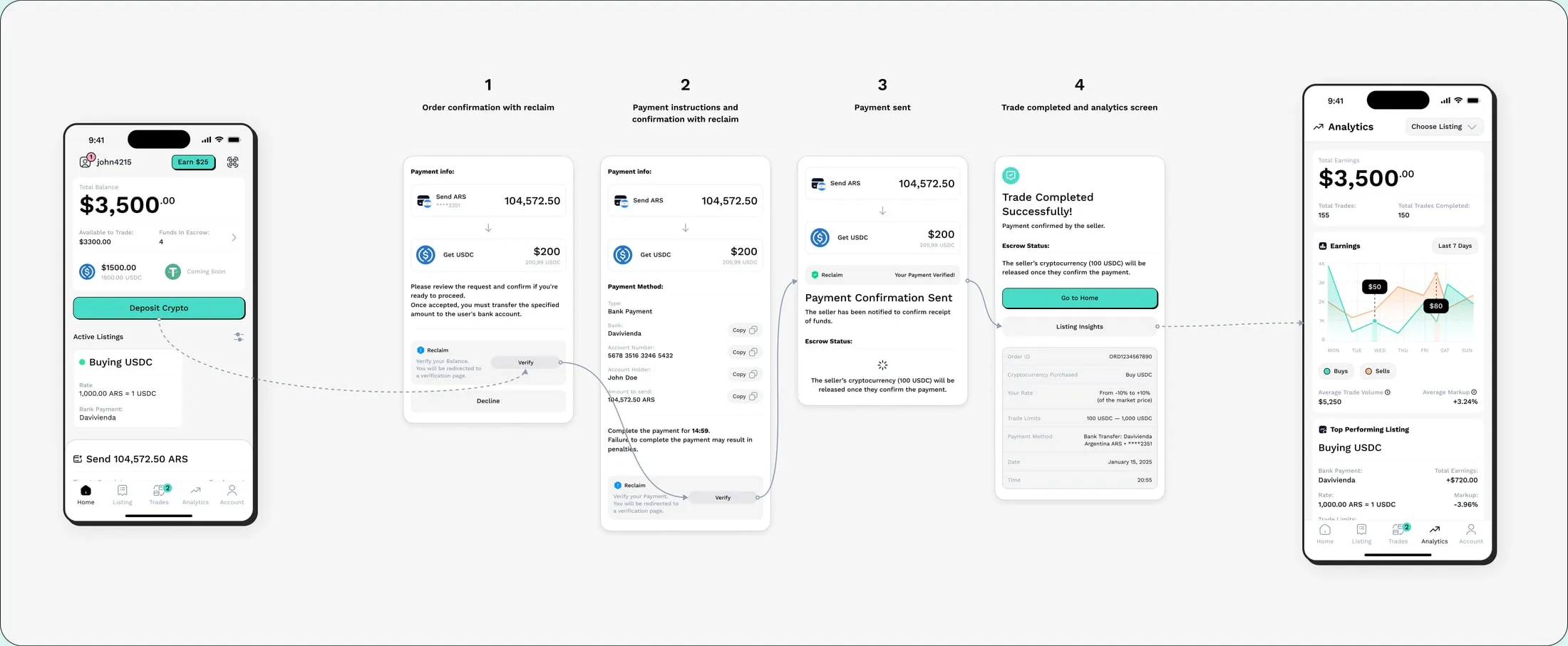 Trading as a vendor
social
The posts and memes on this identity are by the team’s SMM manager.

result
The service launched.
The web service and the landing page run at unigox.com. By the counters on the site, more than 2,300 trades went through the service, there are more than 6,400 wallets, and Coinbase, Polygon and Circle are among the partners.